Sell or lease container systems, then attach service, seed, hygiene, and monitoring revenue.
Research dossier Eastern Europe Updated July 2026
Hydroponic fodder infrastructure
Drought-proof your feed. Scale your profits.
A modular sprouted-grain startup can be credible in Eastern Europe, but not as a commodity wet-feed delivery company. The better case is local infrastructure: container systems, paid pilots, maintenance, seed, hygiene, monitoring, and financing.
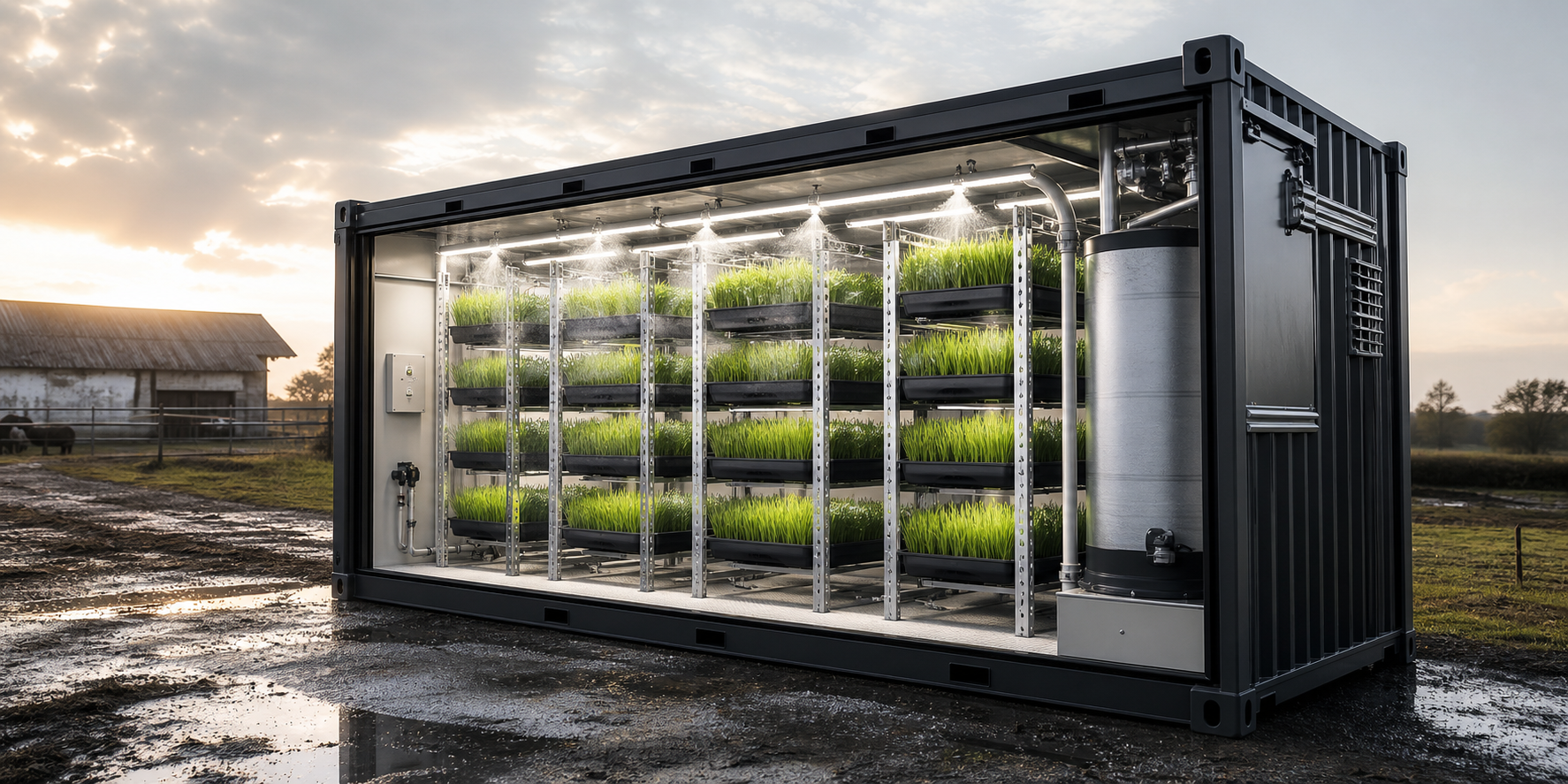
Infrastructure first, fodder sales second.
Hydroponic fodder systems germinate cereal grains such as barley, wheat, oats, sorghum, and corn in controlled trays. They can produce a consistent green mat in less than a week, and that mat can be useful for palatability, daily supplementing, traceability, and resilience during drought or winter pressure.
The economic trap is fresh weight. One kilogram of grain can become five to seven kilograms of green fodder, but most of that increase is water. Farms buy nutrition and animal performance, so the business must be transparent about dry matter, mold risk, labor, energy, and operating discipline.
Base case uses 500 kg/day fresh fodder and 90% annual utilization.
Fresh yield is mostly water uptake, so feed value must be measured on dry matter and animal response.
Hardware sales become more attractive once fixed team costs are covered by repeat deployments.
Do not sell it as cheap bulk feed
At 12-15% dry matter, sprouted fodder can look inexpensive by fresh tonne and expensive by nutrient tonne. The honest position is premium supplement, drought insurance, and daily green-feed control.
Sell the production asset
The stronger B2B company is a local manufacturer/operator of hydroponic fodder containers with installation, support, monitoring, and maintenance revenue.
Use production as evidence
A demo unit should prove animal acceptance, mold control, energy use, labor workflow, and local demand before scaling hardware production.
A feed-constrained market needs resilience capacity, not another commodity feed.
The model should start from current cereal economics. A conservative Eastern European assumption is €190-€230 per tonne for feed barley or feed wheat, rising to €210-€250 per tonne once seed quality, cleaning, handling, and loss are included.
Feed grain baseline
Model feed barley or feed wheat around €190-€230/t, then add 5-15% for cleaning, handling, germination quality, and storage loss.
Practical seed assumption: €210-€250/t.Best-fit farms
Dairy farms, organic dairy, sheep and goat dairies, drought-exposed farms, land-constrained farms, agritourism producers, and larger farms with internal maintenance teams.
Avoid farms with cheap land, cheap forage, and weak margins.Climate pressure
The strategic value is not only price. It is a farm-owned way to produce a predictable fresh supplement through drought, winter, harvest shocks, and storage uncertainty.
Frame as resilience capacity, not replacement feed.| Input | Conservative assumption |
|---|---|
| Feed barley / feed wheat seed | €190-€230 per tonne |
| Clean seed premium, handling, storage loss | +5% to +15% |
| Practical seed cost in system | €210-€250 per tonne |
| Lower-cost path | Buy after harvest, clean and grade in bulk |
| Higher-cost path | Bagged, cleaned, high-germination seed |
| Segment | Why they may buy |
|---|---|
| Dairy farms with 100-500 cows | Need consistent ration and may pay for health or milk-yield gains |
| Organic dairy / organic sheep | Organic feed is expensive, making on-farm sprouting more attractive |
| Sheep and goat dairies | Smaller animals make fresh supplementation easier to test |
| Drought-risk farms | Indoor fodder gives predictable daily output |
| Land-constrained farms | Less dependency on pasture and hay acreage |
| Premium meat/milk or agritourism | Visible sustainability and traceability story |
What the 20-foot system is expected to do.
A typical unit combines an insulated or refrigerated container, trays, racks, soaking, irrigation, drainage, water treatment, airflow, humidity control, lighting, and sensors. The crop cycle is short enough to create a continuous daily harvest, but short cycles also punish poor hygiene.
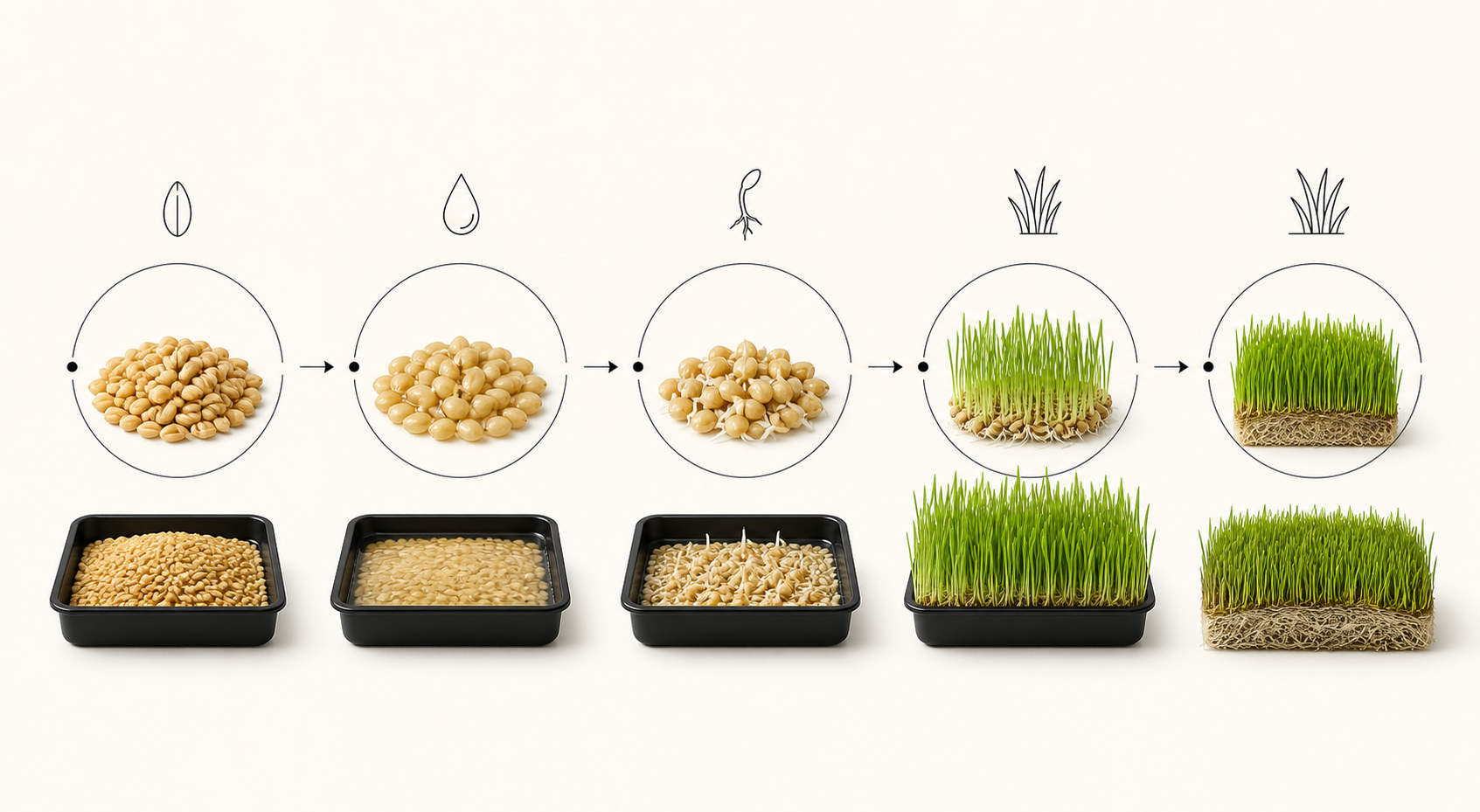
Most systems harvest young cereal mats within one week.
Base case uses 6x fresh output from dry grain.
For 500 kg/day fresh output at 6x yield.
Reference assumption for a 500 kg/day 20-foot unit.
500 kg/day at 90% utilization.
Not a full ration replacement without nutritionist modelling.
| Parameter | Assumption |
|---|---|
| Fresh fodder output | 400-600 kg/day |
| Base output | 500 kg/day |
| Annual utilization | 85-92% |
| Annual saleable fresh fodder | ~155-168 t/year |
| Growth cycle | 6-8 days |
| Seed-to-fresh yield | 5.5x-6.5x |
| Dry matter of fresh fodder | 12-15% |
Economics
The fresh-fodder business looks better by fresh tonne than by dry-matter tonne.
The charts below use the research reference assumptions: 500 kg/day fresh output, 90% utilization, 6x yield, €210/t seed, €0.20/kWh electricity, €60k build cost over seven years, and 13% dry matter.
- Hay~€212/t DM
- Feed barley grain~€239/t DM
- Sprouted fodder, €130/t~€1,000/t DM
- Sprouted fodder, €180/t~€1,385/t DM
Seed€5.7k
Electricity€5.9k
Water€0.3k
Labor€3.3k
Cleaning€1.6k
Maintenance€2.5k
Depreciation€8.6k
- €110/t-€9.9k
- €130/t-€6.7k
- €150/t-€3.4k
- €180/t€1.6k
- €220/t€8.1k
- 3 units€75k GP
- 5 units€125k GP
- 8 units€200k GP
- 12 units€300k GP
- 20 units€500k GP
Play with the numbers
Scenario calculator
Defaults match the research case: 500 kg/day, 90% utilization, 6x yield, €210/t seed, €0.20/kWh electricity, €60k build cost, €180/t fresh selling price, eight units/year, and €25k hardware margin per unit.
| Route | Practical cost range | Implication |
|---|---|---|
| Imported Chinese turnkey | €31k-€53k landed | Low purchase price, higher localization/support burden |
| Local Eastern European build | €42k-€109k | Best defensibility if service and reliability are strong |
| Lean MVP local build | €45k-€60k | Viable demo target if automation scope is controlled |
| Robust commercial unit | €65k-€90k | More realistic for warranty-backed sales |
| Western premium turnkey | Often far higher | Creates room for a mid-price regional supplier |
| Product | Suggested price |
|---|---|
| 20-foot basic, manual loading | €60k-€70k |
| 20-foot standard automated | €80k-€95k |
| 20-foot premium with remote monitoring | €100k-€120k |
| 40-foot 1 t/day unit | €140k-€190k |
| Lease structure | €10k-€20k setup + €1.8k-€2.8k/month |
The commercial company should look like a farm infrastructure supplier.
A single container selling fresh fodder at €180/t produces only about €10k/year cash profit before overhead in the base case. That can support demonstrations and local customer acquisition, but it is not enough to build a scalable startup. Hardware sales change the shape of the business.
Sell eight standard systems per year and the model can produce roughly €680k revenue, €200k hardware gross profit, and enough margin to support a small technical team before recurring revenue matures.
Maintenance contract
€250-€600/month for support, parts planning, and system reliability.
Remote monitoring
€100-€250/month for dashboard access, alerts, and production analytics.
Seed supply margin
€20-€50/t seed where sourcing, cleaning, and germination quality are managed.
Hygiene kit
€50-€150/month for cleaning consumables, filters, and protocol compliance.
Annual service visit
€1k-€2.5k for inspection, calibration, and preventive maintenance.
Operator training
€1k-€3k upfront to reduce mold risk, labor creep, and process drift.
Operational risk is the product.
The buyer is not only buying trays and a container. They are buying confidence that mold, energy, labor, water, cleaning, and animal acceptance will stay under control after installation.
Mold and contamination
Seed sterilization, airflow, cleaning SOP, drainage, and water monitoring.
Farmer overexpectation
Sell as supplement, not full replacement. Use nutritionist-backed ration modelling.
Dry-matter economics
Show fresh-weight and dry-matter economics side by side.
Energy cost
Insulation, efficient HVAC, off-peak operation, and solar-ready option.
Labor creep
Tray ergonomics, automation, checklists, and daily operating standards.
Delivery cost
Keep fresh sales inside a 30-50 km radius or prioritize on-farm systems.
Cheap imported systems
Compete on local service, warranty, spare parts, hygiene, and response time.
Seasonality of demand
Target drought, winter, organic, and dairy consistency use cases.
Recommended go-to-market plan.
Start with €150k-€250k for a serious demo, farm trials, lab tests, nutritionist support, and two to three paid pilots. Move to €330k-€680k for commercial launch only once system reliability and customer willingness are visible.
MVP demo container
Build one serious 20-foot demo unit and measure the real operating envelope before scaling sales.
- 450-550 kg/day output
- Mold loss below 3%
- Labor below 1.5 h/day
- Energy below 80-120 kWh/day
Paid pilot farms
Sell 2-3 discounted but paid pilot systems in exchange for performance data, testimonials, and farm-visit access.
- €60k-€75k pilot price
- Animal acceptance after 7-14 days
- Nutritionist review
- Signed references
Commercial launch
Move to standard pricing and attach recurring service, seed, hygiene, and monitoring revenue.
- 5-8 systems/year
- €450k-€750k revenue
- €10k-€40k service revenue
- Break-even to profitable
Regional scale
Expand through distributors, leasing partners, farm demos, and multi-container deployments.
- 10-15 systems/year
- €900k-€1.4M revenue
- €50k-€150k service revenue
- Disciplined operations
Source notes
Assumptions are visible by design.
European Commission cereals statistics
EU cereal market observatory context for wheat, barley, maize, production, prices, and trade.
European Commission short-term outlookCurrent EU agricultural market outlook for crop and livestock context.
Eurostat livestock and meat statisticsEU livestock base, production, and price-statistics context.
Copernicus European State of the Climate 2024Climate-pressure context for heat, drought, water stress, and weather volatility.